

INTEGRATION AND DATA SERVICES

Secure transmission of information
Custody & Settlement
Strate is tasked with the safekeeping and administration of securities and financial instruments on behalf of third parties. We are also responsible for the settlement of these securities - where the corresponding cash is delivered and received to complete a transaction between sellers and buyers of those securities.
This is the core service we provide to stakeholders across the bonds, equities and money markets.

Our services include the settlement of all transactions concluded on various exchanges in the equities market, including 4AX, A2X Markets, EESE, the JSE Ltd and ZAR X.
We also provides an asset-servicing product range to augment the services we offer to issuers in terms of the Companies Act No. 71 of 2008 and the Financial Markets Act No. 19 of 2012.

In 2017, Strate introduced a new bond clearing and settlement system called the Debt Instrument Solution.
Strate also provides an asset servicing product range to augment the services it offers to issuers in terms of the Companies Act No. 71 of 2008 and the Financial Markets Act No. 19 of 2012.

Strate provides settlement services for the South African money market. Dematerialised money market attributes in South Africa include standardised and electronically issued money market securities, same day settlement, electronic recording of trades in money market securities, and electronic clearing and settlement of money market trades.
Collateral management
As a neutral collateral agent, we handle all the allocation, optimisation and substitution with straight-through processing and in real time.
Strate’s Collateral Management Services (SCMS) is a tri-party collateral agent which offers the supervision of securities that are held as collateral to cover exposures of any bilateral principal agreement. SCMS was the first integrated agency-based collateral management service launched by Strate as part of our mission to continuously provide innovative products for the South African financial markets.
Why Strate is the best positioned to offer Tri-Party Collateral Management:
- We are a neutral agent
- We are independent
- We are a rusted third party
- We have the ability to optimise client assets with real-time inventory
Tri-Party Collateralised Loans
Through centralising collateral management, clients have control over counterparty relationships and are able to automate the administrative burden associated with managing exposures by outsourcing the monitoring and managing of numerous activities. Collateral placed is evaluated and reconciled daily, ensuring all exposures are optimally covered, while eligibility and sufficiency of collateral for both giver and receiver is monitored in real-time.
The TCMS can be used for the collateralisation of various exposures, such as bilateral cash loans, Credit Support Annex (CSA) margining, central bank discount borrowing, securities lending transactions, over-the-counter derivatives, member’ margin obligations with the Central Counterparty (CCP) and collateral pledges in favour of the central bank, amongst others.
Transfer of securities is free of payment (FOP).
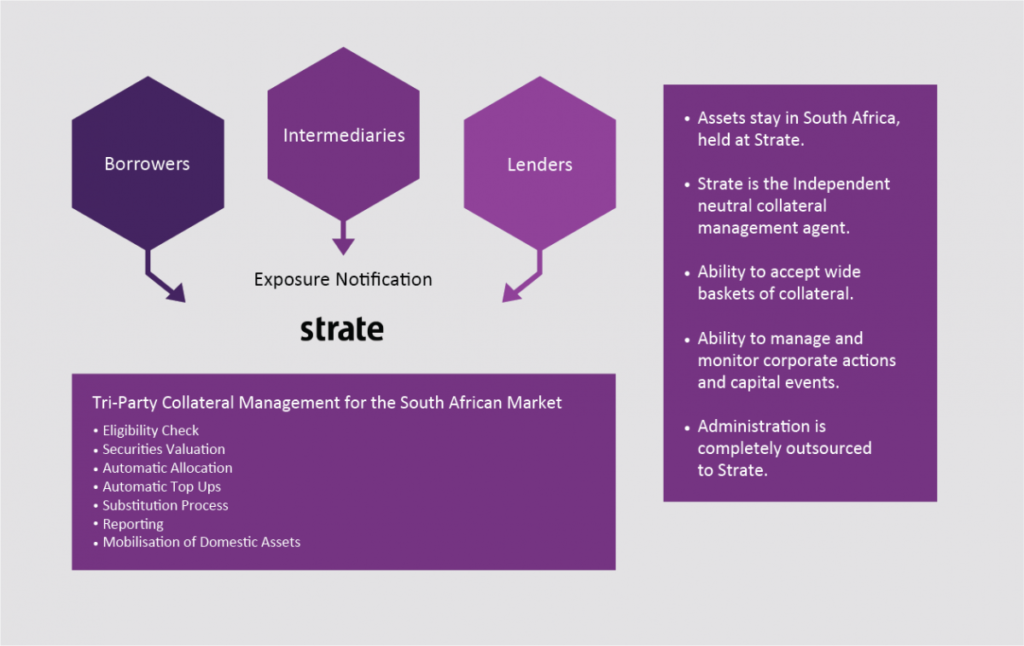

Why Collateralised Loans with Us?
- Automatic allocation and delivery of securities against open exposures.
- Lower Risk through Segregated Depository Accounts and the ability to restrict the re-use of collateral ceded.
- Reduction in operational and settlement risk and the concomitant administrative burden associated with using securities as collateral.

Tri Party Repo (TRS)
Through centralising collateral management, clients have control over counterparty relationships and are able to automate the administrative burden associated with managing exposures by outsourcing the monitoring and managing of numerous activities. Collateral placed is evaluated and reconciled daily, ensuring all exposures are optimally covered, while eligibility and sufficiency of collateral for both giver and receiver is monitored in real-time.
The TCMS can be used for the collateralisation of various exposures, such as bilateral cash loans, Credit Support Annex (CSA) margining, central bank discount borrowing, securities lending transactions, over-the-counter (OTC) derivatives, member’ margin obligations with the Central Counterparty (CCP) and collateral pledges in favour of the central bank, amongst others.
Transfer of securities is free of payment (FOP).
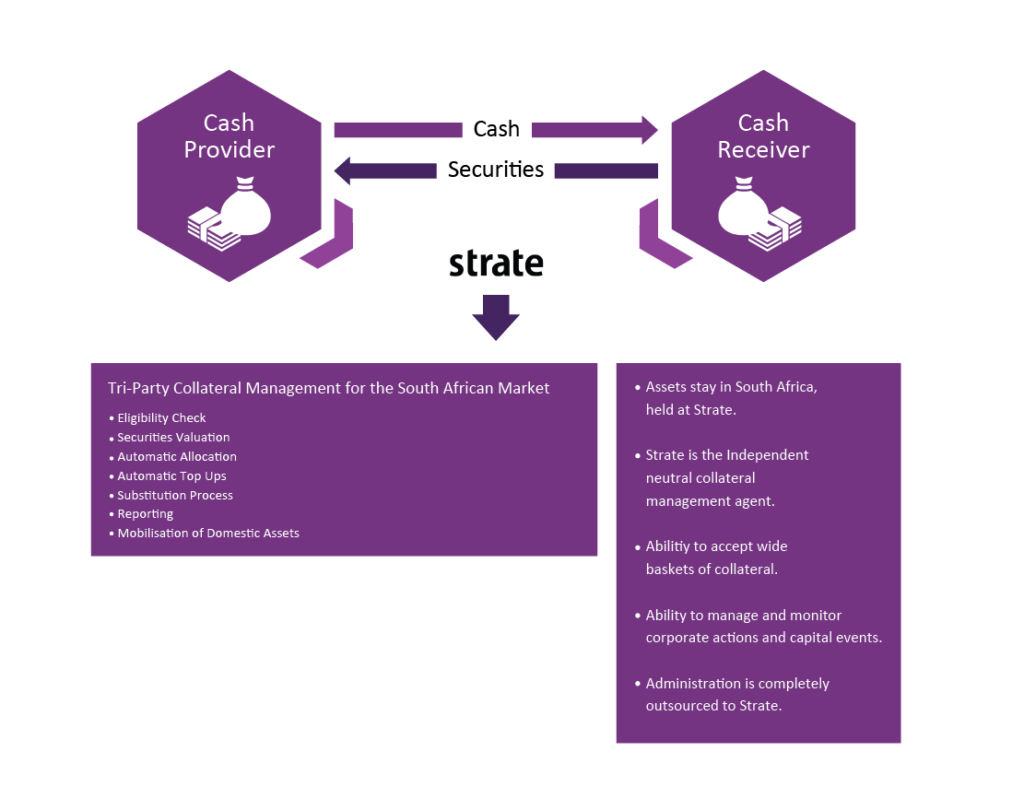
Why execute Tri-Party Repo through Us?
- Lower counterparty credit risk through collateralisation of cash deposits resulting in equal or better long-term yield.
- Lower risk through Segregated Depository Accounts and the ability to restrict the re-use of collateral ceded.Diversification and dynamic collateral.
IT services
Information Technology within the STRATE business

The South African financial market makes payments and securities-related transactions through the Society for Worldwide Interbank Financial Telecommunication (SWIFT) network. Strate manages one of Africa’s largest SWIFT infrastructures and allows clients access to the SWIFT network through this infrastructure. Strate’s centralised SWIFT Services allow market players to save costs and, ultimately, introduce new efficiencies to their own organisations.

Strate’s Gateway Services provide the South African financial market with an alternate mechanism to send and receive International Organisation for Standardisation (ISO) 15022 format messages directly to and from Strate, thereby realising cost savings. The Gateway application processes and routes messages to and from the required Strate target application and stores a copy of the messages on a database at Strate’s high availability infrastructure. The messages are stored for five years and thereafter archived.
Legal entity identifier
The Legal Entity Identifier (LEI) is a 20-digit reference code to uniquely identify legally distinct entities that engage in financial transactions and associated reference data. More specifically, LEI is a unique 20 digit code that is assigned to a legal entity.
The initiative is designed to create a global reference data system that uniquely identifies every legal entity, in any jurisdiction, that is party to a financial transaction.
Two fundamental principles of the LEI code are:
- Uniqueness: an LEI is assigned to a unique entity. Once assigned to an entity, and even if this entity has for instance ceased to exist, a code should never be assigned to another entity.
- Exclusivity: a legal entity that has obtained an LEI cannot obtain another one. Entities may port the maintenance of their LEI from one operator to another. The LEI remains unchanged in the process.
Issuer and investor needs
The very nature of Strate’s activities means that we can offer a number of complimentary services to the market.
Issuers of listed and unlisted companies, investors and other market players can benefit from a number of Strate’s services, listed in the blocks below.
We execute all corporate action events in respect of uncertificated securities for the market. A corporate action is an event initiated by a listed company that affects the securities issued by that company.
Our corporate actions model provides significant risk reduction and cost savings for our clients, given that corporate action payments are processed through the South African Reserve Bank.
Strate Asset Servicing (SAS) provides the management and processing of historical company data, Tax and Proxy Voting Services, as well as ISO Notifications to the investment community.
SAS provides a single-sourced standardised format of information that exists for a corporate actions announcement. It allows market players and investors to make quick and accurate decisions from the simultaneous dissemination and processing of information across the market, without interference from downstream parties and systems.
Segregated Depository Accounts (SDAs) allow investors to open an account directly at the CSD level while maintaining all their existing relationships and services with their custodian.
Their functionality significantly enhances the portability of a client’s holdings, allowing them to engage with an alternate service provider at short notice.
We offer unlisted companies a facility whereby they are able to dematerialise, clear and settle shares in the Strate environment. This includes the processing of corporate action events, such as dividend and interest payments, rights and capitalisation issues.
We produce the BND by collating shareholder positions from information that is supplied by CSD Participants, Brokers and Approved Nominees. Strate full beneficiary disclosure to issuers and/or their appointed agents on a monthly or on a weekly basis.
An electronic voting solution for shareholder meetings using blockchain technology is going to be introduced to South Africa’s financial markets. The envisaged blockchain-based solution will answer many shareholder and issuer’ frustrations, as it will eliminate the current manual processes that are prone to errors, as well as the barriers to shareholder participation in decision-making at meetings, including annual general meetings (AGMs).
Blockchain can provide the market an end-to-end, secure, and reliable solution. It provides an immutable record with a cryptographically secure ledger of transactions and we are able to secure a vote in the blockchain in a far more efficient and user-friendly manner than any other technology that we have in existence.
For all shareholders, both local and foreign, it is important that the voting process is streamlined and transparent and that the meeting results are reported precisely, quickly and with guaranteed finality, so that the results can be relied on in a legally-binding way. The use of e-Voting would enable the shareholder to submit a vote online using an authorised login. This will be automatically processed, removing the potential for human error and giving the company voting results in real-time, enhancing corporate governance as a result.
